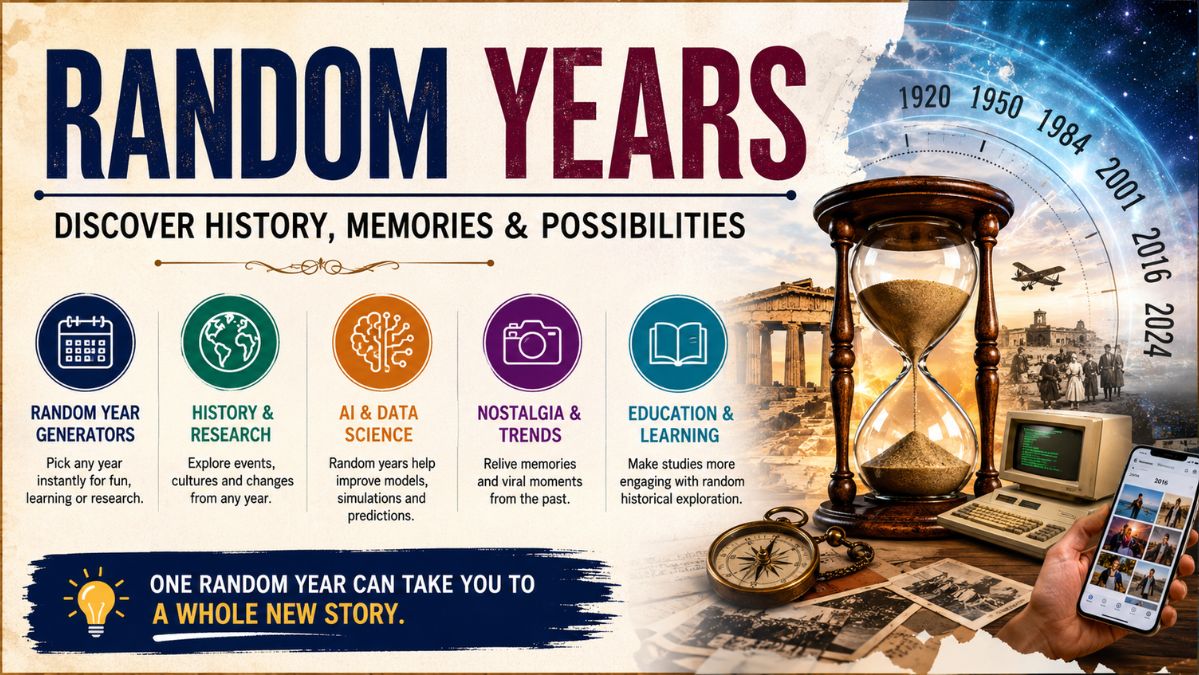
The concept of Random Years has become surprisingly popular across the internet. From educational tools and historical research to nostalgia trends and artificial intelligence, random years are now used in many creative and practical ways. Whether someone wants to generate a random historical year for a school project, explore forgotten moments in history, or simply relive memories from a past decade, the idea continues to grow in popularity.
In recent years, random year generators, timeline tools, and history-based content have gained attention on blogs, social media platforms, and educational websites. Teachers use random years to make history lessons more interactive, researchers use them for statistical analysis, and content creators use them to spark curiosity and engagement.
The internet’s fascination with “Random Years” reflects a broader human interest in unpredictability, nostalgia, and discovery. Every year in history contains stories, innovations, wars, cultural shifts, and life-changing events. Selecting a random year can instantly open the door to a completely different world.
Quick Bio Tabl
| Topic | Details |
|---|---|
| Keyword | Random Years |
| Main Category | Education / Technology |
| Common Use | Random year generation and historical exploration |
| Popular Online Tools | Random Year Generators |
| Related Topics | History, AI, Statistics, Nostalgia |
| Search Intent | Informational |
| Trending Usage | Social media nostalgia trends |
| SEO Potential | Medium to High |
| Best Audience | Students, researchers, bloggers, history lovers |
Understanding the Meaning of Random Years
The term “Random Years” generally refers to years selected without a fixed pattern or sequence. These years may come from a random generator, computer algorithm, or manual selection process. The concept sounds simple, but it has applications in many industries and fields.
For example, a student researching the 1800s might use a random year generator to choose a year for a classroom presentation. A data scientist may use random years while testing machine-learning models. Social media creators may use random years to create nostalgic content such as “Photos from 2012” or “Things everyone forgot about 2007.”
Because every year has unique historical events attached to it, even a randomly selected year can become fascinating.
The Rise of Random Year Generators
One major reason behind the popularity of this keyword is the growth of online random year generator tools. These websites allow users to instantly generate years from custom ranges.
For instance, users can:
- Generate years between 1900 and 2025
- Pick historical years randomly
- Create timeline challenges
- Build quiz games
- Generate fictional settings for stories
Many educational blogs recommend random year generators for classroom activities because they encourage exploration and curiosity. Students become more engaged when they are assigned unexpected historical years rather than familiar textbook topics.
Random year tools are also used by writers. Novelists and scriptwriters sometimes select to build alternate-history stories or period-based narratives.
Why Humans Are Fascinated by Randomness
Humans naturally enjoy randomness because it creates surprise and excitement. Psychologists explain that unpredictable outcomes trigger curiosity in the brain. That is why people enjoy:
- Lottery systems
- Random music playlists
- Random video recommendations
- Random travel ideas
- Random historical facts
Random years work in a similar way. When someone sees a year like 1984, 1453, or 2001 appear randomly, curiosity immediately follows. People begin wondering:
- What happened during that year?
- Which inventions existed?
- What major historical events occurred?
- What was daily life like?
This psychological attraction helps explain why random year content performs well on social media and search engines.
Random Years in Historical Research
Historians and researchers often use during data analysis and academic studies. Selecting random years can reduce bias and improve objectivity.
For example:
- Climate researchers may analyze random years of weather data
- Economists may compare random financial periods
- Sociologists may sample random census years
- Historians may examine cultural changes across randomly selected eras
Using random years allows researchers to avoid focusing only on famous or dramatic periods. Instead, they can study ordinary years that also shaped society.
This method helps reveal hidden patterns in economics, politics, population growth, and environmental change.
and Artificial Intelligence
Artificial intelligence systems frequently use random data generation during training and testing. Random years may appear in:
- Machine learning datasets
- Predictive algorithms
- Simulation software
- Statistical models
- Testing environments
For example, an AI model predicting climate trends may train on weather information from randomly selected years. Financial prediction systems may analyze stock market behavior from random economic cycles.
Randomness improves AI learning because it exposes systems to broader variations instead of repetitive patterns.
As AI technology continues growing, random year generation may become even more important in data science and predictive analytics.
Social Media Nostalgia Trends
Another reason the keyword “Random Years” has gained attention is nostalgia culture. Social media users love revisiting old memories from random periods in their lives.
Popular trends include:
- “Take me back to 2016”
- “Random photos from 2009”
- “Life in 1998”
- “Things only 2000s kids remember”
Platforms like TikTok, Instagram, and Facebook are filled with nostalgic posts tied to random years. People often feel emotionally connected to music, fashion, technology, and memories from specific periods.
These trends perform well because nostalgia creates emotional engagement. Users enjoy comparing past lifestyles with modern life.
For bloggers, this opens opportunities to create content such as:
- Best memories from random years
- Technology through the decades
- Fashion trends by year
- Historical events timelines
Educational Benefits of Random Years
Teachers increasingly use random years to make learning more interactive. Instead of assigning students the same common historical topics repeatedly, educators use random years to encourage unique research projects.
Benefits include:
- Increased curiosity
- Better critical thinking
- More diverse historical exploration
- Improved creativity
- Reduced repetitive assignments
For example, a teacher may ask students to research:
- Major inventions in a randomly assigned year
- Political events from a selected decade
- Daily life in a random century
- Music and entertainment trends from a specific year
This teaching style transforms history from memorization into discovery.
Random Years in Entertainment and Gaming
Entertainment industries also use random years in creative ways. Video games often generate random historical settings or fictional timelines. Movies and TV shows sometimes explore alternate years or parallel histories.
Examples include:
- Time-travel stories
- Alternate history films
- Historical simulation games
- Randomized timeline challenges
Some online trivia games even challenge players to guess events connected to randomly selected years.
These interactive experiences help audiences engage with history in a fun and memorable way.
SEO Potential of the Keyword “Random Years”
From an SEO perspective, “Random Years” is an interesting keyword because it has broad search intent and relatively low competition compared to highly saturated history terms.
Potential article topics include:
- Best Random Year Generators
- Why Random Years Matter in Research
- Random Historical Facts by Year
- How AI Uses Random Years
- Exploring History Through Random Years
Long-form informational content can rank well if optimized with:
- Historical examples
- Educational insights
- Interactive ideas
- Timeline references
- Trending nostalgia discussions
Since the keyword appeals to students, bloggers, researchers, and casual readers, it offers flexible content opportunities.
The Future of Random Year Content
The popularity of random years will likely continue growing due to:
- AI-generated tools
- Educational technology
- Social media nostalgia
- Interactive web experiences
- Historical curiosity
As people seek more personalized and engaging content online, random discovery systems are becoming more valuable. Random year generators may eventually include AI-powered historical summaries, interactive timelines, and multimedia storytelling experiences.
This evolution could transform how people explore history and learn about the past.
Final Thoughts
Random Years may sound like a simple concept, but it connects deeply with technology, psychology, education, entertainment, and history. From academic research and AI systems to nostalgic social media trends, random years continue influencing how people discover information and revisit the past.
The keyword also offers strong opportunities for bloggers and content creators looking to produce educational or trend-driven articles. With creativity and proper SEO optimization, articles around random years can attract readers interested in history, technology, and digital culture.