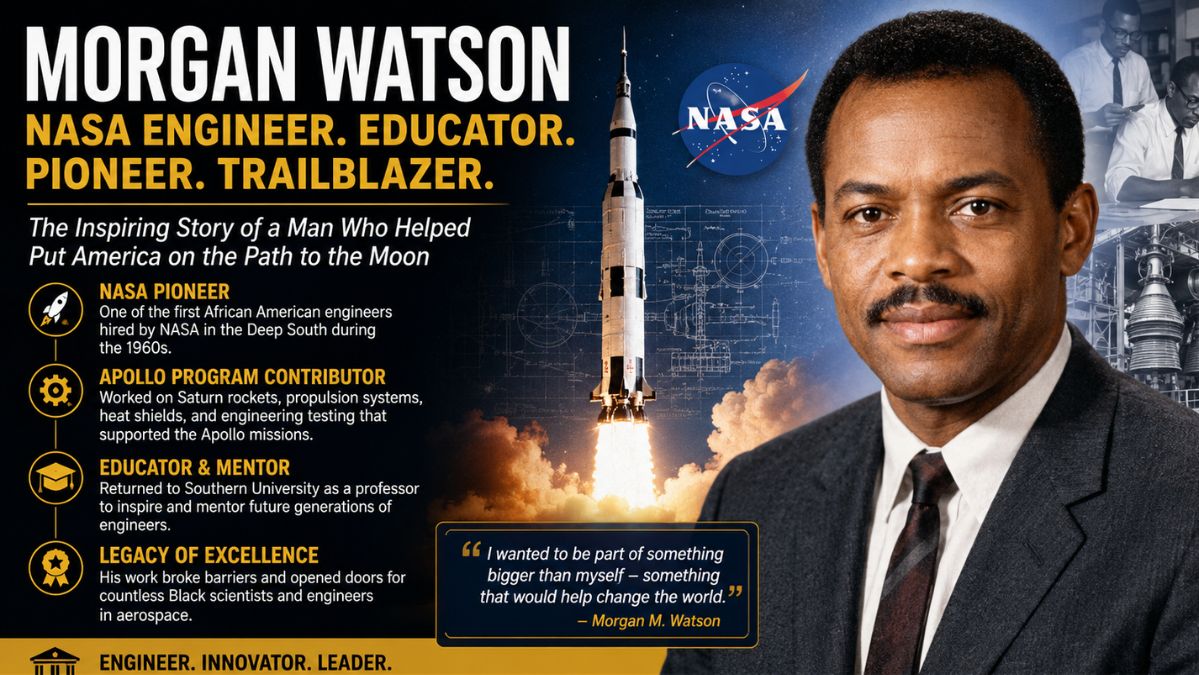
The history of space exploration is filled with brilliant scientists, engineers, and innovators who helped humanity reach the Moon. Among those remarkable individuals is Morgan Watson, a pioneering African American engineer whose work at NASA contributed to the advancement of America’s space program during one of the most important eras in scientific history.
Morgan Watson’s journey is not only a story about engineering and space technology but also one of determination, education, and breaking racial barriers in the United States during the civil rights era. His contributions to aerospace engineering, education, and entrepreneurship continue to inspire students and professionals today.
Quick Bio Table
| Field | Details |
|---|---|
| Full Name | Morgan M. Watson |
| Known For | NASA Engineer and Educator |
| Birth Date | November 25, 1943 |
| Birthplace | Louisiana, United States |
| Profession | Mechanical Engineer, Professor, Entrepreneur |
| Education | Southern University |
| Famous Work | Apollo-era NASA engineering projects |
| Industry | Aerospace Engineering |
| Legacy | One of the first African American engineers at NASA in the Deep South |
Early Life and Childhood
Morgan Watson was born and raised in rural Louisiana during a period when racial segregation was still deeply rooted in American society. Growing up in a farming community, Watson experienced many of the hardships faced by African American families in the South during the 1940s and 1950s.
As a child, he worked in cotton fields while also focusing heavily on his education. Despite limited opportunities, Watson showed exceptional talent in mathematics and science from a young age. Teachers and community mentors recognized his intelligence early and encouraged him to pursue higher education.
One story often mentioned in biographies about Morgan Watson is how a local hardware store owner inspired him to think about engineering as a career path. At a time when very few African Americans entered technical professions, this encouragement played a major role in shaping his future ambitions.
His upbringing taught him discipline, perseverance, and hard work—qualities that later became essential in his engineering career.
Education and Academic Success
Morgan Watson attended Southern University, one of the leading historically Black colleges and universities in the United States. During his time there, he studied mechanical engineering and developed advanced technical skills that would eventually help him secure opportunities at NASA.
In the 1960s, engineering programs were highly competitive, and African American students often faced systemic barriers in education and employment. Nevertheless, Watson excelled academically and demonstrated the expertise required for the rapidly growing aerospace industry.
His education at Southern University not only provided technical training but also connected him with mentors and opportunities that would shape his professional future.
Entering NASA During the Space Race
The 1960s marked the height of the Cold War space race between the United States and the Soviet Union. NASA was aggressively recruiting engineers and scientists to help America achieve its ambitious goal of landing astronauts on the Moon.
Morgan Watson became one of the first African American engineers hired by NASA in the Deep South. This achievement was historically significant because racial discrimination remained widespread at the time, especially in technical and scientific industries.
At NASA, Watson worked on projects connected to:
- Saturn rocket systems
- Apollo mission technologies
- Rocket propulsion testing
- Heat shield systems
- Aerospace quality assurance
These projects were essential to the success of America’s lunar missions.
Working at NASA during this period required long hours, precision, and deep technical knowledge. Engineers like Watson helped solve complex challenges involving rocket performance, structural safety, and spacecraft reliability.
Contributions to the Apollo Program
One of the most fascinating aspects of Morgan Watson’s career is his connection to the Apollo program. NASA’s Apollo missions represented one of humanity’s greatest scientific achievements, eventually leading to the historic Apollo 11 Moon landing in 1969.
Watson contributed to engineering systems associated with the Saturn rockets that powered Apollo missions into space. The Saturn V rocket remains one of the most powerful rockets ever built, and its development required thousands of engineers working together.
His responsibilities reportedly included:
- Mechanical system analysis
- Rocket testing procedures
- Thermal protection systems
- Engineering calculations
- Technical documentation
Some biographies also note that Watson worked with early computer systems to automate engineering processes. During the 1960s, computer technology was still developing, making this work especially innovative for its time.
Although many NASA engineers worked behind the scenes, their contributions were critical to ensuring astronaut safety and mission success.
Breaking Racial Barriers
Morgan Watson’s success carried importance beyond engineering. He became part of a generation of African American professionals who challenged racial discrimination in science, technology, and higher education.
During the civil rights movement, opportunities for Black engineers were extremely limited. Many companies and institutions refused to hire African Americans for technical positions. Watson’s achievements demonstrated that talent and determination could overcome social barriers.
His story is often compared to other pioneering Black NASA professionals featured in historical accounts about diversity in aerospace engineering.
Watson also became involved in civil rights progress in Louisiana. Historical references mention that he was among the first African Americans registered to vote in his local parish after passing discriminatory literacy tests used during segregation.
This combination of scientific achievement and civil rights progress makes his story particularly powerful.
Career Beyond NASA
After his work in aerospace engineering, Morgan Watson returned to Louisiana and continued contributing to education and business development.
He later became a professor at Southern University, where he taught engineering and mentored future generations of students. His teaching career allowed him to share real-world aerospace experience with aspiring engineers.
Many students viewed Watson as a role model because he proved that African Americans could succeed in advanced scientific fields despite social obstacles.
In addition to teaching, Watson reportedly founded one of the first Black-owned engineering consulting firms in the Deep South. This entrepreneurial achievement further expanded his influence in engineering and business communities.
His work helped create opportunities for minority professionals in technical industries.
Recognition and Legacy
Over the years, Morgan Watson received recognition for his achievements in engineering and education. Southern University honored him for his contributions to science, mentorship, and academic leadership.
His story has also been included in discussions about:
- Black history in STEM
- NASA diversity initiatives
- Civil rights pioneers
- African American engineers
Books and documentaries focusing on Black NASA professionals frequently highlight engineers like Watson who helped shape the American space program during the Apollo era.
One notable publication connected to this history is We Could Not Fail, a book documenting African American contributions to NASA’s success during the space race.
Today, Morgan Watson’s legacy continues to inspire:
- Engineering students
- Young scientists
- Minority professionals
- Space enthusiasts
- Historians studying the civil rights era
Why Morgan Watson’s Story Matters Today
The story of Morgan Watson remains highly relevant in today’s world because it represents the importance of perseverance, education, and equal opportunity.
Modern discussions about diversity in STEM fields often focus on increasing representation in science and technology careers. Watson’s journey demonstrates how talent can flourish when opportunities are made accessible.
His life also reminds people that many important contributors to NASA’s success worked quietly behind the scenes without widespread recognition.
As space exploration continues with missions to Mars and beyond, the achievements of pioneering engineers like Morgan Watson remain an important part of aerospace history.
Final Thoughts
Morgan Watson’s life is an inspiring example of determination, intelligence, and courage. From humble beginnings in rural Louisiana to becoming a respected NASA engineer and educator, he helped break barriers during one of the most transformative periods in American history.
His contributions to the Apollo-era space program, engineering education, and civil rights progress continue to leave a lasting impact. Morgan Watson’s story deserves greater recognition because it highlights the individuals whose dedication helped shape both technological innovation and social change.